
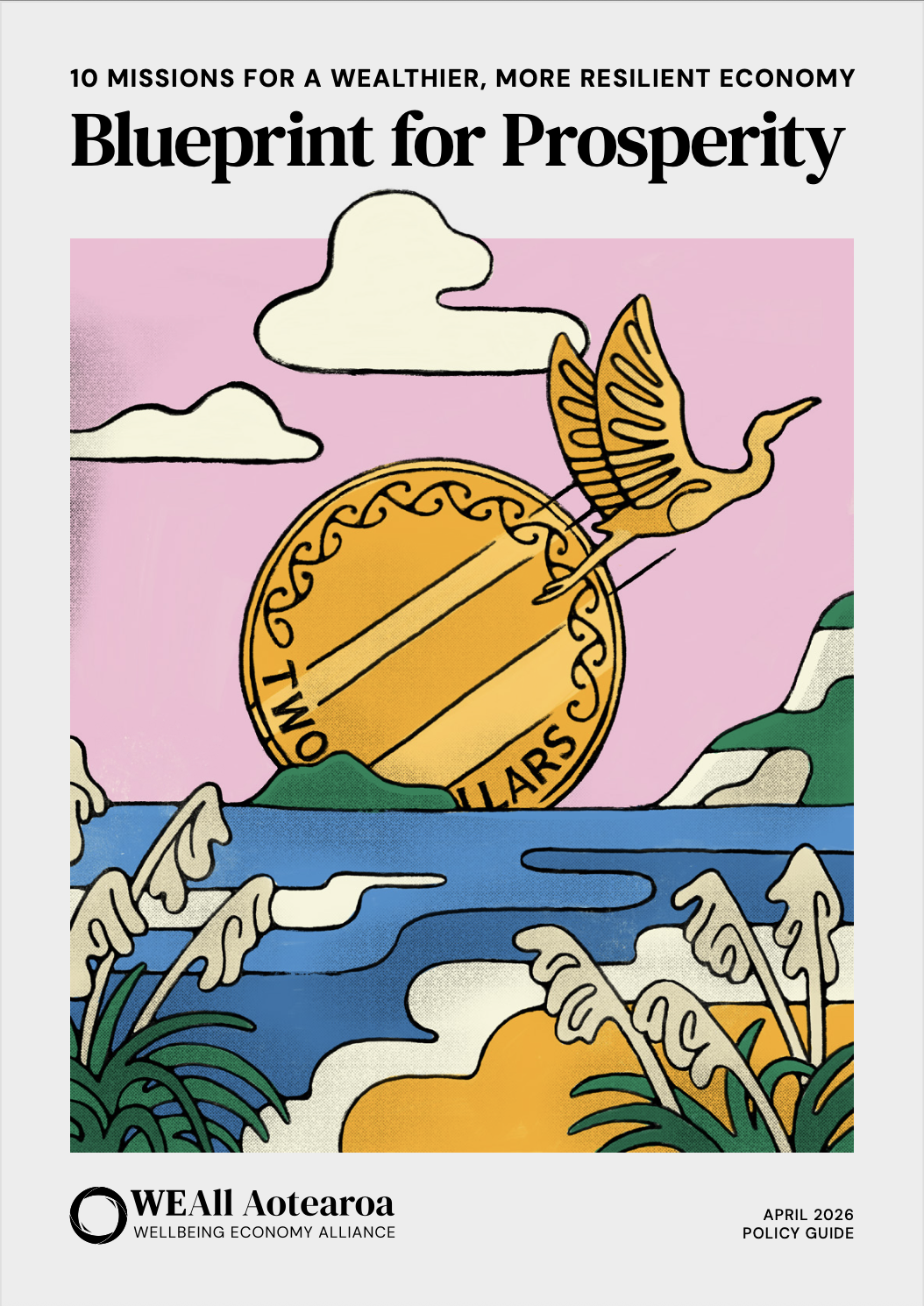
Aotearoa New Zealand can have an economy that is well-positioned for the future -
One that meets the needs of all of us and improves the lives of future generations, cares for our environment and is resilient to shocks.
To achieve a wealthier, more resilient Aotearoa we need transformational change—change that challenges the status quo and addresses the root causes of inequality and environmental degradation.
The purpose of this policy guide is to provide politicians and everyday New Zealanders with practical policy recommendations to care for the common wealth of our country.
To politicians, we urge you to be more ambitious for Aotearoa: stop kicking the can down the road and leave the decades of siloed, short-term, bottom of the cliff thinking in the past.
To all New Zealanders, we invite you to champion this alternative future we can have for Aotearoa. It’s time for a redesign.
Read on to learn about the Blueprint and to see how you can get involved in redesigning our economy in service to life.
Adopting a mission-led approach
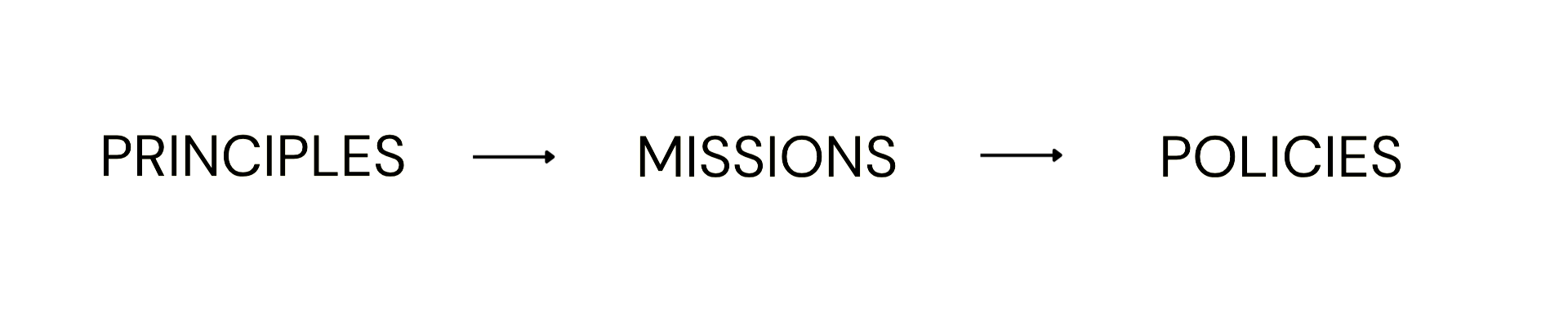
In this guide we share five principles of modern economic systems design that lead to 10 missions for Aotearoa.
In doing so we have drawn inspiration from Mariana Mazzucato’s work on a Mission Economy. A mission-led approach calls for an active role of government in addressing big challenges and creating the conditions for everyone to lead a good life.
From there we share 33 evidence-based policies to address our most pressing challenges at the systemic level.
Five principles for a modern, resilient economy
-

Purpose
Reorient the purpose of the economy to deliver human and ecological wellbeing.
-

Prevention
Act upstream and tackle root causes rather than symptoms.
-
Pre-distribution
Design fairness into the system so that power, wealth, time, and income are equitably shared before problems arise.
-
Participation
Ensure communities have a real voice in shaping their futures.
-

Place
Ground solutions in place so they are tailored, locally-led and reflect Aotearoa’s uniqueness.
Ten missions for Aotearoa
One: Build the wealth of New Zealand in every sense. We can be one of the wealthiest nations — not just in financial terms, but in the wellbeing of our people, communities, and environment.
Treating GDP as the main measure of success is no longer enough. GDP measures how much is bought and sold, not whether life is getting better. Vape sales, car crashes and disaster recovery costs add to GDP, while unpaid care, stronger communities, and the restoration of rivers, beaches, and forests are barely counted at all.
In New Zealand, economic growth has been accompanied by rising child poverty and inequality. We grow GDP while eroding the foundations of long-term prosperity — shifting costs onto future generations, degrading nature, weakening community wealth, and underinvesting in the capabilities people and businesses need to thrive.
New Zealand needs a more strategic approach than simply chasing growth for its own sake. We should judge success by the outcomes we achieve: lower child poverty, better health and education, affordable homes, a lighter environmental footprint, and an economy that creates good jobs and rising incomes. That means investing in research and development, building a smarter and more productive economy, and making sure the gains are shared fairly.
Two: Renew public ownership for the public good. At the local, regional, and national level, public assets and services such as schools and hospitals help provide the foundations of life. They support our livelihoods, living standards, and collective wellbeing. Over the past 40 years, New Zealanders have seen the loss of assets once held in common ownership and the growth of privately owned, for-profit services that too often put returns ahead of public need.
To build a wealthier, more resilient Aotearoa New Zealand, we should renew public ownership for the public good.
Three: Invest in prevention to tackle problems at their root. We can break the costly cycle of paying to fix what we continue to break. The concept of ‘failure demand’ refers to unnecessary demand that is created when systems do not work effectively or are designed to solve the wrong problem..
When systems focus on symptoms, demand and costs tend to increase over time. When they identify and address root causes, unnecessary demand is reduced and long-term costs can be avoided.
A more preventative approach to public investment would reduce future spending pressures, make government more financially resilient, and improve life outcomes for individuals and communities. It would also reduce reliance on acute services such as hospitals, prisons, and emergency housing. For example, investment in primary health (including dental) is not just a cost today; it also delivers healthier communities and better outcomes over the long term. The key message is simple: investing early and solving the right problem reduces both demand and cost.
Four: Create a fairer tax system that funds what matters and supports better lives. We need a rebalanced tax system to prevent inequality and create the fiscal foundation required to build better lives for all New Zealanders.
Right now, our tax system is unbalanced and New Zealand depends more than any other OECD countries on a relatively narrow range of taxes on income and consumption. That means working people pay tax on every dollar they earn through wages and salaries, and on what they spend on everyday essentials, while the wealthiest can face lower effective tax rates, benefit from untaxed capital gains, and large corporations can take advantage of loopholes.
A rebalanced tax system would share wealth more equally, raise revenue more fairly, and provide greater capacity to deliver universal basic services, protect pay equity, and support public investment so we can have better schools, hospitals, and infrastructure. Essentially, supporting us to invest in the things we need. Tax can also shape behaviour, to reduce the things we don’t want, like inequality or environmental harm, public health harm or speculative economic behaviour. By changing the costs and benefits of different choices, tax can nudge individuals and corporations toward or away from certain actions.
New Zealand also has one of the most centralised systems of government in the world with most tax revenue going to central government. Not only is our local government smaller compared to similar countries, its revenue model is unsustainable. Local government needs a new funding model that is fit for the future so it can continue to deliver for our towns, cities, and regions.
Five: Make a modern promise so that everyone has the income to live in dignity. We all want to live in thriving communities where everyone has what they need to build a good life. And healthy communities are built through many kinds of contribution: raising children, caring for whānau, volunteering, learning, and supporting others, as well as paid work. Our economy depends on all of these, yet how they are valued and remunerated does not always reflect their true worth.
It is also important to understand that our income system has not kept pace with the realities of modern life. In the past, a parent in an ordinary job could afford to buy a house and support a family. Today, even with two parents working more than 40 hours a week, families can still struggle to pay the bills, and four in ten children living in poverty already have a parent in full-time work. People who can work for a living should be able to earn a proper living, while those who cannot should still have the support to live a good life. Our inadequate benefit system drives people deeper into poverty that’s difficult to get out of and reduces their ability to participate in society.
The economy could not function without the full spectrum of community contribution. Future governments should make a modern promise that reflects this and ensures that everyone has the income to live with dignity.
Six: Grow our common wealth by putting the public back into public finance. Public spending, banking, and finance should be tools for building a wealthier, more resilient Aotearoa New Zealand. The Government’s finances are not the same as a household budget and an overly narrow focus on keeping spending and debt low can come at the cost of future opportunity. Over the last 40 years, New Zealand’s neoliberal approach to public finance has prioritised fiscal restraint above long-term social, economic, and environmental investment. While New Zealand has generally maintained lower public debt and a smaller public sector than many OECD countries, this has too often come alongside underinvestment in infrastructure and preventable social costs that weaken future economic resilience. Recent tax changes have also added pressure to the fiscal outlook at a time when long-term investment needs are growing.
Our financial system is designed in a way that works best for those who already own wealth. We need a banking and finance system that serves the wider public good — supporting productive investment, fair access to capital, and long-term national development, not only private profit.
Seven: Renew democracy by giving people a stronger voice in the decisions that shape their lives. We can renew and strengthen our democracy, make better collective decisions and build stronger social cohesion by empowering active citizens.
Our current decision-making processes are poorly designed to encourage genuine participation, build broad long-term agreement, and protect the interests of future generations. Democratic engagement is also in long-term decline and New Zealanders are far less likely than in the past to be active in political parties, civil society or community organisations.
However, in 2025, polling for WEAll Aotearoa found 84% of New Zealanders want our major political parties, from across the spectrum, to work together to find long-term solutions to major challenges that affect our future wellbeing, such as climate change, healthcare, and poverty reduction.
Everyday citizens hold the key to democratic revitalisation, and participatory democracy – which emphasises the active, direct participation of citizens in shaping the policies and decisions that affect their lives and communities – is a tool we can use to achieve this.
Eight: Give people more power in economic decisions that affect their lives. We can make our economy more equal by design by scaling up inclusive and democratic business models so they make up a much larger share of the economy.
New Zealand is a highly unequal country when it comes to wealth. In the past, we were often described as one of the world’s more egalitarian societies, especially in the post-war period, although that reputation was always uneven and excluded significant inequalities, particularly for Māori and women. Since the neoliberal economic reforms, however, wealth has become increasingly concentrated at the top, especially in the ownership of assets. People are becoming more disillusioned about their opportunities and less trusting of the system. A 2024 poll found that 65 per cent of respondents agreed that New Zealand’s economy is rigged to advantage the rich and powerful.
To create a more equal and cohesive economy, we need to increase democratic ownership and control of businesses, land, and financial assets. Solutions include encouraging co-operatives, employee-owned businesses, social enterprises, and Māori and Pasifika-owned businesses. The Government can be a powerful driver of this change through legislation and public procurement. In this way, we can help ensure wealth is distributed in a way that serves everyone’s needs, not just those who are already wealthy.
Nine: Place Te Tiriti at the heart of modern Aotearoa to create good lives for all. Te Tiriti o Waitangi is a living framework for partnership and shared decision-making, and provides a pathway to a shared future where all of us can have good lives in a flourishing living world.
Tangata whenua (indigenous peoples) have the right to self-determination and sovereignty, as affirmed in Te Tiriti o Waitangi and He Whakaputanga, yet the Crown continues to breach Te Tiriti and has excluded Māori from decisions about how the economy is designed. That must change.
The economy as it exists today was imposed on tangata whenua through colonisation. For centuries before colonisation, tangata whenua lived under sophisticated legal and social systems, grounded in tikanga (customs / protocol) that emphasised balance, reciprocity, and collective wellbeing. These systems endure today and have much to offer a modern economy designed around human and ecological wellbeing.
Within the current economic system, Māori businesses and organisations are often constrained from operating according to their own values and aspirations. The Crown, as the regulator and steward of the economy, has an obligation to protect tino rangatiratanga and the integrity of Māori economic approaches.
Te Tiriti o Waitangi should be upheld across every policy in this guide. But there are also specific reforms that would enable its more systemic expression and help bring Te Tiriti to life as a foundation for transformational change in power, governance, and economic design in Aotearoa.
Ten: Restore nature so it can flourish in Aotearoa. Our environment is the foundation of our prosperity. New Zealanders are deeply connected to the natural world and, if we are to thrive, we must restore our rivers, lands, and seas, because when nature flourishes, so do our communities.
Yet the living world is under growing pressure from human exploitation and wasteful patterns of production and consumption. Our current unsustainable and unjust economic system has pushed the world beyond seven of the nine planetary boundaries that regulate the stability and resilience of the Earth system, and the Stockholm Resilience Centre warns that crossing these boundaries increases the risk of large-scale, abrupt, or irreversible environmental change.
Restoring nature is an investment in the long-term resilience and prosperity of Aotearoa New Zealand. Native forests and wetlands help store carbon, reduce flood risk, improve water quality, strengthen biodiversity, and support the health of communities and ecosystems. WWF-New Zealand and EY estimate that protecting nature could save Aotearoa New Zealand more than $270 billion over the next 50 years, showing that the cost of inaction is far greater than the cost of restoration.
Our economic system still too often rewards profit from social and environmental harm. It privileges short-term shareholder value even when that means exploiting workers, depleting natural resources, and pushing environmental costs onto others. We need to move beyond individualism, greed, short-termism, extractivism, commodification, and waste, and instead build an economy that restores and protects the natural systems all life depends on.
We’ve done it before, we can do it again
The economy is a product of design, it can be redesigned. Indeed, we’ve done it before.
Many of the rules shaping today’s economic system can be traced back to the neoliberal reforms of the 1980s, when policymakers championed free markets, deregulation, and low taxes. These changes fuelled a period of rapid economic growth across much of the Western world.
In Aotearoa New Zealand, this period of history is marked by the introduction of ‘Rogernomics’, a set of policies and reforms led by Finance Minister Roger Douglas. Most of these policies he took from a briefing paper he received from Treasury officials, when elected in 1984 called ‘Economic Management’.
40 years later, we now know that our current economic system is not ensuring the wellbeing of all people and places as well as it could. Fresh ideas are needed to address the modern challenges we now face.
We’ve taken a leaf out of the neoliberal playbook in the development of Blueprint for Prosperity.
The rapid reforms show that it is possible to redesign the economy.
This time, let’s do it with people and planet at the centre.

“Economic Management” - the influential briefing given to the incoming New Zealand Government in 1984.
Next steps and ways you can contribute
This is part of an ongoing conversation about the kind of economy New Zealanders want and need.
The next phase will involve interviews with academics, iwi, and community organisations, building towards a comprehensive briefing to the incoming government in 2027, complete with scenarios and pathways to give decision-makers the evidence they need to act with confidence.
Sign up to our newsletter to get updates. Or get in touch below.


Research
The breadth of this project is significant, we are seeking support for specific research questions depending on your expertise. Please get in touch if you can contribute.
Funding
We are inviting funding from both individuals and organisations. You can donate here.

Connections
Connect us with individuals and organisations you think would be interested in or could contribute to this project.
Let’s leave neoliberalism in the 1980s
Blueprint for Prosperity
10 MISSIONS FOR A WEALTHIER, MORE RESILIENT ECONOMY