
Caiyah Farrell: Fighting for Oceania’s Future
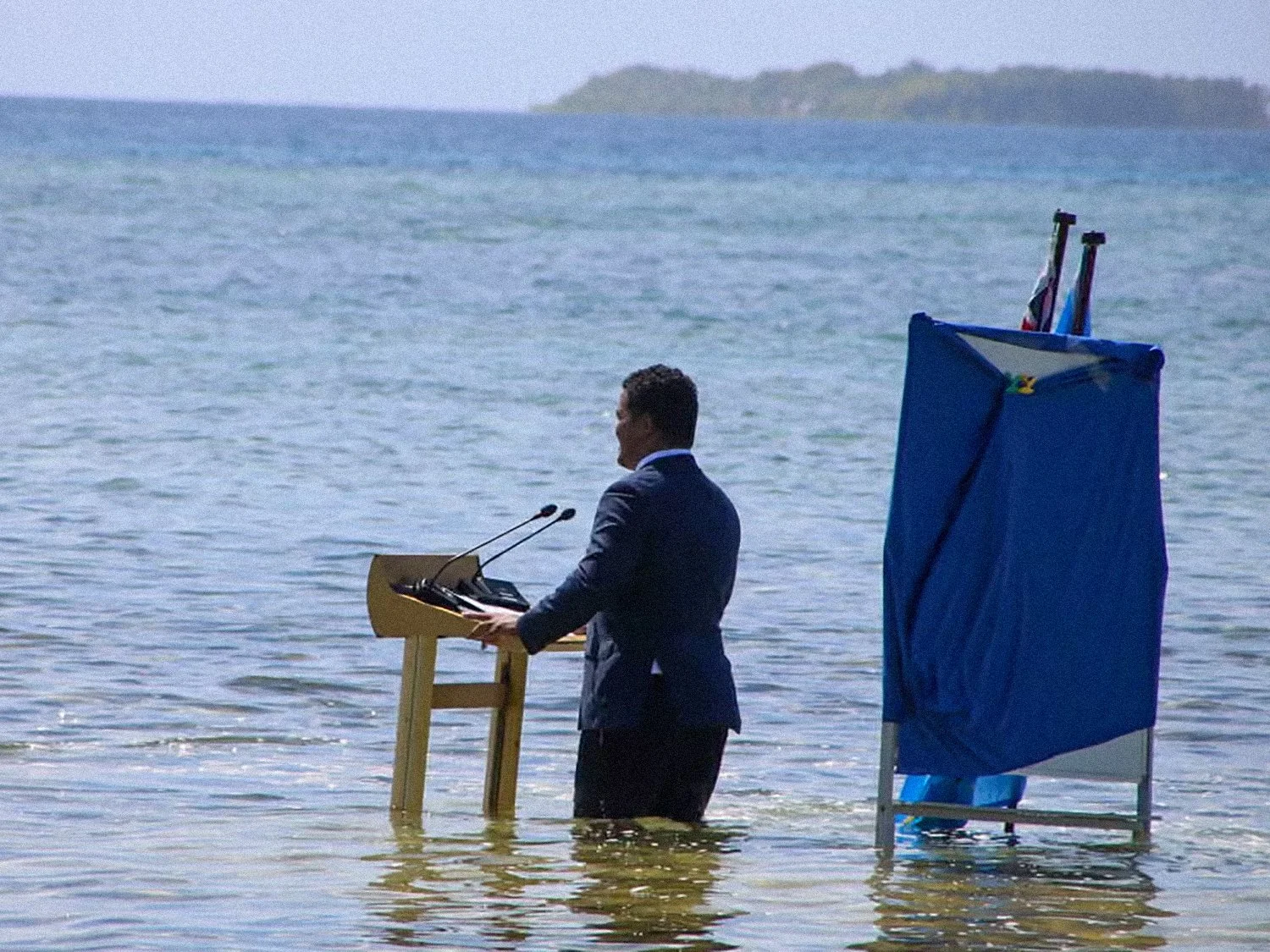
“We are sinking, but so is everyone else.”
- Simon Kofe, at the 2021 United Nations conference.
Simon Kofe stands solemnly, the saltwater washing past his knees as he gives his impassioned speech. He stands in the waters of Tuvalu, water that was never supposed to be there. Yet, as sea levels continue to rise, not enough is being done to ensure the safety and sovereignty of the low-lying atoll nations that make up our sea of islands. Climate change and by extension sea level rise act as ongoing forms of colonialism. Hidden behind the guise of climate change, it threatens Indigenous sovereignty, identity and relations to their sacred land. However, through cosmology, ancestral knowledge and indigenous innovation, the people of Tuvalu demonstrate an anti-colonial assertion of their unique identity, fostering wellbeing, strength and resilience.
Pollution is not just the harms caused by industry, but an active assertion of colonial power. “Pollution and wasting (of Land, of Life) … produces whiteness and settlement.” (Liboiron 2021, p. 77). They describe it as an enforcement of settler entitlement to land, reinforcing the idea of ‘terra nullius’, perpetuating the extractive practices it uses to guarantee colonial control. Under the colonial hegemony, land is treated as a colonised resource, an extractable commodity. Land is objectified into Resource, where it is exploited to safeguard settler futures. Ngata (2019) describes it succinctly.
“... when you talk about a system that extracts from our lands to profit another, when you talk about a system that spells the end of our way of being, that forces us to worry about our very survival, that impacts our food systems, our bodies, our human rights—we know this experience very well. We call it colonisation” (p. 88)
Indigenous people across the globe have already been experiencing this type of colonisation since the beginning of history.
Liboiron also discusses a different type of relation known as Land. Land, here, is used as a proper noun, personifying and relating to Land in a way that honors its specificities, varying obligations, and local knowledge. By practicing this, Land becomes part of identity founded in human kinship. One could say that Tuvaluan indigenous beliefs are an example of Land relations, but I argue it is simply the other way round — indigenous knowledge has been and always will be the blueprint for good Land relations. However, indigenous knowledge will not make sense in an institution designed to exploit, commodify and erase it, such as the colonial structures of academia. Indigenous systems of living, being and doing challenge the colonial structures that attempt to define or contain them (Liboiron, 2021, Tuck & Yang, 2012). Academic categorisation often requires recognition by dominant institutions, the same institutions that uphold the colonial rhetoric that indigenous peoples — like the people of Tuvalu — actively resist.
“I can Indigenise my world, my home, my family, the worlds of my daughters as much as possible but that ain't going to change who holds the power here.” (Ngata, 2019, pp. 88).
In other words, the recognising entity is also the oppressor. This contradiction means that Indigenous belief systems that foster wellbeing often exist outside of ‘official’ (colonial) recognition. Their legitimacy comes from living, embodied experience and communal assertion through kinship.
Colonialism has always operated as an oppressive force aiming to control, assimilate, and ultimately erase Indigenous peoples. Both Liboiron (2021) and Ngata (2019) argue that capitalism supports colonization by using pollution as a byproduct of maximum extraction. Capitalist industry values growth and profit over ecological wellbeing, enabled by colonialism's erasure of Indigenous governance and knowledge. In Pollution Is Colonialism (Libioron, 2021) the concept of assimilative capacity is introduced and discussed as another form of colonial assertion of power through universalism. “Legibility across jurisdictions, scales, materials, and contexts is likely a core reason Streeter and Phelps’s equation for assimilative capacity was so immediately successful,” (Liboiron 2021, p 21). Developed from a few US river systems, it allowed industry to assume entitlement over land to pollute, coordinate access everywhere and effectively ignore localised conditions. This approach universalises settler ideology and erases complex relationships between people, land and water, reinforcing an imbalance between Indigenous beliefs and colonial power. Liboiron quotes Inuk Jackie Price, referring to this as a “metaphysical flattening”, where all the complexities — relationships to land, ocean, animals, fish and spirit — are erased or ‘flattened’ into a framework easily palatable, and even easier to apply to all bodies of water and land across the globe. This turns assimilative capacity into a tool used to destroy Indigenous relations, in order to replace them with a set of easily quantifyable scientific rules that justify its exploitation as a Resource. This universalism underscores the colonial assumption that all Resource, all places, are the same – completely erasing local indigenous relations.
As a result of colonial powers using the Pacific Ocean as a sink for Waste, sea level rise continues to plague the people of Tuvalu (Lazarus, 2015). Pollution here is colonial, because it functions under the colonial assumption that indigenous Land (and by extension, ocean) should be forced to absorb a certain amount of harm that is decided not by the people that live there, but by the colonial hegemony that wishes to exploit them (Liboiron 2021). Sea level rise is one of the many consequences of this and functions under the same logic, just scaled up slightly where global pollution is literally drowning and harming pacific peoples. One of the many ways colonialism asserts its power is through environmental harm, because loss of land equates to a loss of identity, and therefore a loss of sovereignty (Falefou 2017, Liboiron 2021).
In Toku Tia, Falefou explains that if Tuvaluans were to lose their land entirely, “they would no longer have the full extent of national and cultural identity, because they know their identity only comes from their ancestral land.” (p. 144). Tuvaluan identity is bound to the land and ocean, to the spiritual and genealogical relationships that define their existence. To lose land is to lose part of the self. It's a loss of one’s history, ancestors, and place in the world. Falefou captures this vividly through another metaphor: the land and the placenta. In Tuvaluan language, the two words are closely related, reflecting the idea that the land is a living mother, and the people are her children. “Land is essential to Pacific people and to dichotomise the relationship is the same as dissecting the unborn baby from the placenta” (Falefou, 2017, p. 145). Without a placenta, the baby will perish. Without land, the people perish, not just physically, but spiritually and genealogically too. Leaving their islands is a kind of funeral, a loss of heart, soul, and loved ones.
Indigenous epistemologies, such as those of Tuvalu, directly counter colonial universalism by grounding knowledge in specificity and scale. Liboiron (2021) describes specificity as knowledge that is place-based and grounded in good Land relations. They argue that Land is “fundamentally relational” (p. 45) and that those relations are specific to each place and community. This is what is meant by Land relations. Indigenous cultures develop kinship-based relationships with Land over generations, establishing an “educational process that was practical, ultimately ecological, and spiritual” (Cajete 2000, in Liboiron, 2021). Liboiron capitalises the “L” in Land because it is a proper name. “the shorthand for all these relations as a proper name that is specific and unique, not universal and common” (Liboiron, 2021, p. 45). This emphasis on specificity resists colonial attempts to universalise and flatten Indigenous relationships to place.
Similarly, Liboiron defines scale as “what relationships matter within a particular context” (2021, p. 84). In Indigenous worldviews, scale determines the relevance of relationships — proximity, kinship, and connection determine how we should respond. In contrast, colonial ideologies treat scale as universal, which enables extractive access to Land under the guise of global systems. For example, from a global or universal scale, rising sea levels may not yet impact the majority of the world. Yet on a local and specific scale, in Tuvalu, sea level rise and climate change are already making life so much harder. The colonial hierarchy of scale obscures these specific realities and relations, allowing harm to continue in Indigenous spaces with little recognition or redress.
Tuvalu is unfortunately situated at the front lines of our climate crisis. The rising seas, salt-poisoned soil, and dying crops (Falefou, 2017) are the lived realities of a people whose existence is inseparable from their land and ocean. As sea levels rise, groundwater salinity has reached levels too high for traditional crops like pulaka and taro to grow. Once-soft, nutrient-rich roots have become stiff, dense, and prone to rot. Coconut trees, which were abundant sources of fruit, toddy, and shelter now produce smaller, less sweet fruit, with even breadfruit trees bearing irregularly, sometimes ripening out of season. During the 2011 drought, Tuvalu was forced to declare a state of national emergency as entire plantations of pulaka and taro died (Tekinene, 2013 in Falefou, 2017).
For centuries, Tuvaluans have measured the health of the land through the vitality of the living things upon it (Talia 2020, Lazarus 2015). This acts as a form of environmental knowledge that is both practical and spiritual. But as climate change intensifies, these weather patterns and ecological cues have become harder to predict, making Indigenous knowledge systems increasingly difficult to practice (Falefou 2017, Lazarus 2015). Subsistence farming, once sustained through intimate ecological understanding, has been pushed to its limit. Communities now rely heavily on imported food and drinking water from larger global powers, creating new hierarchies of dependency that reflect colonial exploitation.
In this context, the Tuvaluan government’s climate change policy, Te Kaniva (a term coined by Falefou), stands as an act of Indigenous reclamation. It draws inspiration from ancestral luni-stella navigation, literally using the stars to guide, symbolising a continuity between ancient cosmology and modern policy. It is a declaration that Tuvalu’s future must still be guided by Indigenous knowledge systems, even as the conditions for practicing them are eroded. At the heart of modern Tuvaluan policy lies the concept of the Coconut People, articulated by Falefou in Toku Tia (2017). The coconut is more than a source of sustenance; it is a living cosmology, a “tree of life” (p. 70) that enabled the settlement and survival of Pacific peoples. “Had it not been for the coconut, the people would not have been so closely connected to the land” (p. 167). The roots of the coconut tree symbolise sovereignty, endurance, and the relational value of Land. Just as a tree cannot live when uprooted, Tuvaluans cannot exist apart from their ancestral land. “Their physical and mental lives are rooted in the land like the coconut tree” (p. 165). As a result, the coconut embodies a more relational ontology, or a way of being, doing, and living with the world that recognises kinship between humans, Land, and spirit. Falefou further deepens this connection through the metaphor of Te Fakamauganiu, the coconut of all coconuts, the founding coconut, the parent from which all others descend. This ancestral coconut represents the unity and shared genealogy of Tuvaluans, a living symbol of solidarity and collective identity. It reminds Tuvaluans that their roots (literal and spiritual) can all be traced back to the same origin. Yet, as sea levels rise and saltwater seeps into the soil, this ancestral rootedness is threatened. What happens to the coconut tree if its roots are poisoned by the saltwater? Climate change does not just endanger ecosystems, it undermines the very systems that sustain Indigenous life.
Coconuts are at the centre of Tuvaluan life and diet, but more importantly, they are woven into the Tuvaluan spirit. “the rootedness of the people of Tuvalu to their land, like coconut roots in the soil” (p. 164). Land is a determinant of status, of kinship, and of belonging. “Land is such a basic determinant of status in the community that people would ensure they would not lose it for any purpose” (p. 165). This deep sense of stewardship, guardianship, and reciprocity is embedded into everyday life and into Tuvalu’s cosmological worldview. The concept of the Coconut People is an ontological truth and a political statement. A living embodiment of identity that asserts resilience, endurance, and connection in the face of colonisation. Tuvalu’s people, like the coconut tree, may bend in the storm, but their roots remain deep. They are anchored in ancestral soil, memory, and spirit.
These ideas of specificity and scale are deeply embodied in Tuvaluan cosmology and daily life through holistic, interweaved wellbeing frameworks, such as ola lei. Much like how the concept of Land is difficult to fully express within Western frameworks (Liboiron 2021, Talia 2020) ola lei is a uniquely Tuvaluan framework for wellbeing. It encompasses both the Department of Health’s definition of “health” and the Tuvaluan concept of “living well.” Developed by Panapa et al. (2021), ola lei uses te feke (the octopus) as a metaphor to represent the complicated diversity and interconnectedness of wellbeing. Each tentacle of the octopus represents a different yet specific aspect of wellbeing, reflecting the variability and relational complexity of Tuvaluan life. “The Tuvalu model of te feke presents the various aspects of wellbeing as intertwined and recognises the key roles played by spirituality, relatedness, vitality, and cultural knowledge and practices” (Panapa et al., 2021, p. 10). One participant noted in Panapa’s paper that the octopus lives in deep water but must occasionally rise above the surface to breathe, a fitting metaphor for Tuvaluans surviving in Tuvalu and elsewhere in the face of climate emergencies. Others suggested that the octopus’ suckers could symbolise how people can become ‘stuck’ in certain practices, while its flexibility and adaptability reflect Tuvalu’s resilience. The four central qualities that form the octopus’ head — filemuu (peacefulness), fiafia (happiness), malosi (fitness), and ola leva (longevity) embody the interconnection between physical, emotional, and spiritual wellbeing. This framework exemplifies Indigenous sovereignty and survivance, a living, embodied assertion of Tuvaluan identity that refuses the proverbial colonial mold. It shows that wellbeing is not a single universal concept but a relational and context-dependent way of living well with one’s environment. Te feke shows how deeply connected Tuvalu is to its land and all living beings within the moana — many of which are now endangered due to climate destruction.
The Tuvaluan ethic of fale pili, meaning “good neighbourliness,” extends this relationality to the global stage. In an interview with the Toda Peace Institute, Tuvalu’s Minister Simon Kofe describes how the government applies fale pili (the duty to look after one’s neighbour) to international climate cooperation. Kofe conceptualises fale pili as an Indigenous model for global responsibility, scaling a local relational ethic into a global one. He describes Tuvalu as a community-based society sustained by relational systems like ola lei, which maintain balance between people and environment. Viewed through Tuvaluan eyes, the world should be made up of global neighbours bound by obligations of respect, consensus-building, and cooperation. Ultimately, Tuvaluan epistemologies like ola lei and fale pili show that Indigenous frameworks offer alternative, life-affirming ways of being in relation with the planet, values that have existed for ages. They demonstrate that living well is inherently relational, specific, and grounded in care. In this sense, Tuvalu’s knowledge systems are not only acts of resistance against the universal colonial hegemony, but also visions for a more ethical and sustainable world.
Tuvalu is transforming crisis into a site of innovation and resistance. The Future Now Project, launched by the Tuvaluan government, represents a new type of sovereignty in the twenty-first century, including the last resort plan to upload an entire nation into the digital world. At its core, the Future Now Project is a continuation of Indigenous cosmology in a new form. It is not a surrender to the rising seas, more an act of preservation, continuity, and reassertion of Tuvaluan sovereignty. By envisioning a digital nation, Tuvalu is ensuring that its culture, governance, and collective memory will endure even if the physical islands disappear beneath the ocean. The project aims to preserve Tuvalu’s land boundaries, legal sovereignty, traditional knowledge, and the lived experience of home. By digitally replicating the nation’s landscapes, cultural practices, and archives, this act directly challenges Eurocentric notions of statehood that define sovereignty through land ownership and physical territory. The Future Now Project draws from values central to Tuvaluan life, which Minister Simon Kofe describes in his interview with the Toda Peace Institute: olaga fakafenua (communal living systems), kaitasi (shared responsibility), and fale pili (being a good neighbour). These principles, grounded in Tuvaluan cosmology, form the foundation for what has been called oceanic diplomacy, diplomatic practices that emerge from Pacific cultures rather than Western political frameworks. Kofe insists that sovereignty can also exist through relational continuity, a distinctly Indigenous understanding of connection that transcends physical borders. Tuvalu’s reimagined diplomacy refuses the inward-looking, nation-centred approaches that enabled this climate crisis in the first place. Instead, it builds outward through obligation, relationality, and care, principles that echo Liboiron’s notions of specificity and scale, where relationships matter most within their particular contexts.
Tuvalu’s potential digital future is both pragmatic and poetic. It is a direct answer to the question: What will Tuvalu do if its land and territory are lost to sea level rise? The Future Now Project pursues domestic, regional, and international legal avenues to secure Tuvalu’s maritime boundaries and sovereignty. But it also carries a hidden message to the rest of the world: we know this crisis is not our fault. The project exposes the moral hypocrisy of the global north, those who caused the climate crisis yet frame Pacific nations as helpless victims. The message is clear: Tuvaluans are not drowning, they are fighting. This contrast reveals a deeper truth about paternalism and the politics of care. Western powers, particularly New Zealand and Australia, often approach Oceania through a paternalistic lens, as caretakers of a fragile region, offering ‘help’ while maintaining control (Hau’ofa, 2008). This echoes Ocean Ripeka’s words in Imagining Decolonisation “A colonised mind leads to colonisation of others.” (2020, p. 49). Even those who see themselves as “decolonised” can reproduce colonial power, regardless of their intentions (Liboiron 2021). The decolonised become colonisers, and Oceania is once again boxed in by the same hierarchies it has fought to escape.
Colonialism enforced artificial boundaries across the Pacific, severing ancestral connections and generating isolation and division. The Future Now Project, however, gestures toward what Oceania was and what it could be again: a family of interconnected islands, united by oceanic kinship. I often find myself asking, what would Oceania look like if colonialism had never suppressed it? I think about this as both a student and a young Indigenous woman navigating academia, a system that has also boxed me in with expectations of profit, productivity, and hierarchy. Tuvalu’s redefinition of sovereignty reclaims the tools of colonial modernity (Such as technology, diplomacy, and law) and wields them for Indigenous survival. In doing so, Tuvalu embodies that obligation, responsibility, and relationality: a refusal to be erased, a refusal to be pitied, and a refusal to disappear. This is resistance as well as resurgence. An assertion of Indigenous power that reimagines survival as a continuation of life, connection, and care.
Bibliography:
Falefou, T. (2017). TOKU TIA: Tuvalu and the impacts of climate change. https://researchcommons.waikato.ac.nz/bitstream/10289/11651/4/thesis.pdf Kofe, S. (2023, September 20). Tuvalu’s Future Now Project: preparing for climate change in the worst-case scenario. Devpolicy Blog From the Development Policy Centre. https://devpolicy.org/tuvalu-preparing-for-climate-change-in-the-worst-case-scenario 20211110/
Lazrus, H. (2015). Risk Perception and Climate Adaptation in Tuvalu: A combined cultural theory and traditional knowledge approach. Human Organization, 74(1), 52–61. https://doi.org/10.17730/humo.74.1.q0667716284749m8
Liboiron, M. (2021). Pollution is colonialism. In Duke University Press eBooks. https://doi.org/10.1515/9781478021445
Ngata, T. (2019). Kia mau: Resisting Colonial Fictions.
Panapa, T., Park, J., Littleton, J., Chambers, A., & Chambers, K. (2021). Towards Indigenous policy and practice: a Tuvaluan framework for wellbeing, Ola Lei. Journal of the Polynesian Society, 130(1), 7–44. https://doi.org/10.15286/jps.130.1.7-44
Simon Kofe. (2021, November 8). Minister Kofe’s video statement: COP26 [Video]. YouTube. https://www.youtube.com/watch?v=hpPTFGwFExg
Talia, M. (n.d.). MIGRATION IS A DEFINITE NO, BUT RATHER A MATTER OF CHOICE| VOICE FROM THE MARGIN. In
https://www.researchgate.net/publication/342407360_MIGRATION_IS_A_DEFINITE NOBUT_RATHER_A_MATTER_OF_CHOICE_VOICE_FROM_THE_MARGIN. Climate Induced Migration, Berlin, Germany.
https://www.researchgate.net/publication/342407360_MIGRATION_IS_A_DEFINIT E_NO_BUT_RATHER_A_MATTER_OF_CHOICE_VOICE_FROM_THE_MARGI N
Toda Peace Institute. (2022, May 14). Tuvalu: Climate Change and Digital Sovereignty │ Simon Kofe [Video]. YouTube. https://www.youtube.com/watch?v=-kV-q8vv1ng Tuck, E., & Yang, K. W. (2012). Decolonization is not a metaphor. Decolonization, Indigineity Education & Society, 1(1).