
A call for economic citizenship
A Call for Economic Citizenship shares a deliberately ambitious alternative to the current draft economics education within Social Studies. Our proposal has four knowledge areas and five practice areas, intended to support students to understand the economy as embedded in social and ecological systems and to develop skills and habits of critical economic and financial literacy for engaged citizenship.
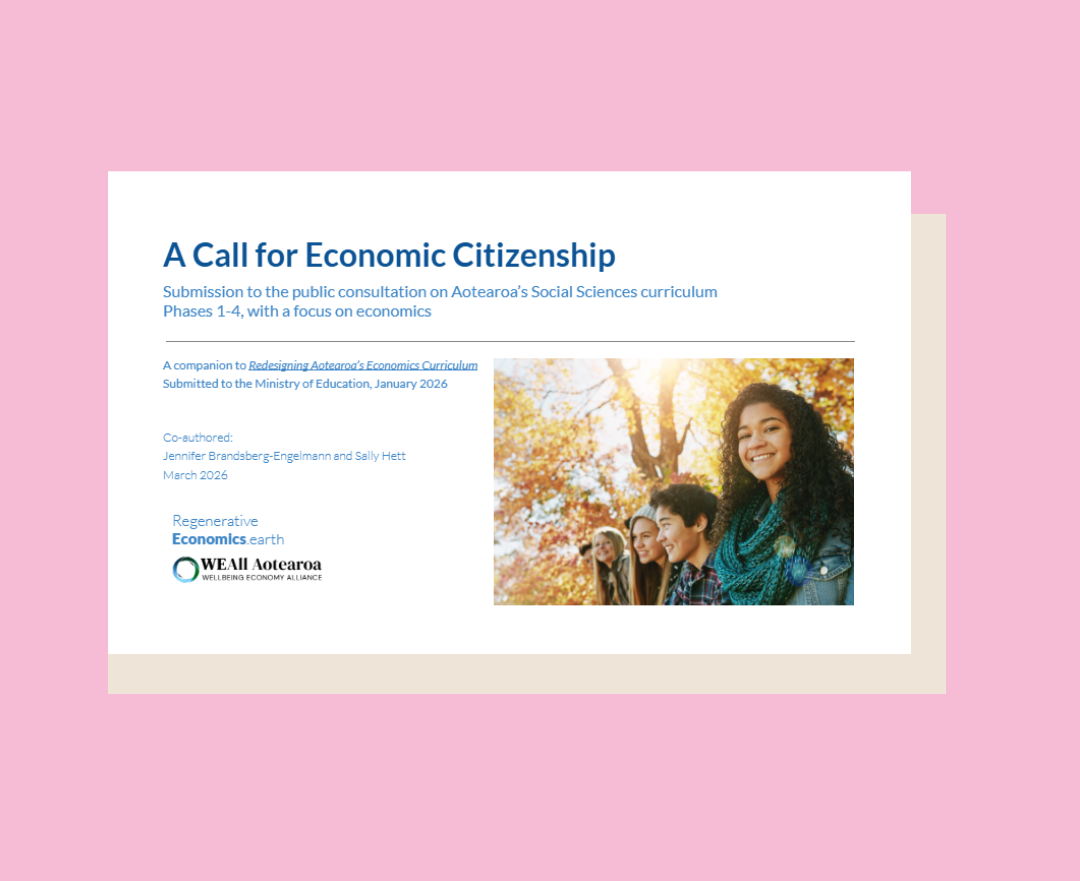
Co-authored by Regenerative Economics (international) and WEAll Aotearoa, the report responds to the Ministry of Education's public consultation on the Social Sciences learning areas. It puts forward a coherent and comprehensive economics curriculum from year 1 to year 10, that compliments the NCEA economics curriculum reform we proposed in our companion report Redesigning Aotearoa's Economics Curriculum: Five Transformative Shifts, submitted to the Ministry of Education in January 2026.
The current draft curriculum frames existing institutions as structures to understand and operate within, rather than as human-made arrangements to be evaluated and, where necessary, challenged and changed. Rather, we propose equipping students with the skills to understand the broader questions; how do we organise collective life in ways that serve the good life for all, and how do we build and defend the institutions that make that possible?
With our proposed curriculum, students will arrive at Year 11 having spent ten years asking what the economy is for, understanding ecological and social embeddedness, exploring all four provisioning institutions, and practising critical and deliberative thinking.
“These students are our future leaders; our future business owners, politicians, public servants, and of course citizens. Their mindset and understanding of the economy, society and the living world is crucial to address the challenges we face. It’s about preparing students for uncertainty, complexity, and real-world decision-making.”
We need a curriculum that is both more pedagogically appropriate and intellectually honest about the rich and diverse relationships of economic life. This report aims to spark meaningful discussion, challenge traditional approaches, and inspire action toward a 21st-century economics curriculum in Aotearoa New Zealand.
We offer this proposal as a contribution to an urgent conversation, grounded in our expertise, informed by international research and practice, and motivated by a genuine belief that economics education in Aotearoa can better serve its communities.
This is a generational opportunity to shape how young people in Aotearoa learn about the economy, society and the living world.
