
Moving Beyond GDP: Our Submission to the UN High-Level Expert Group
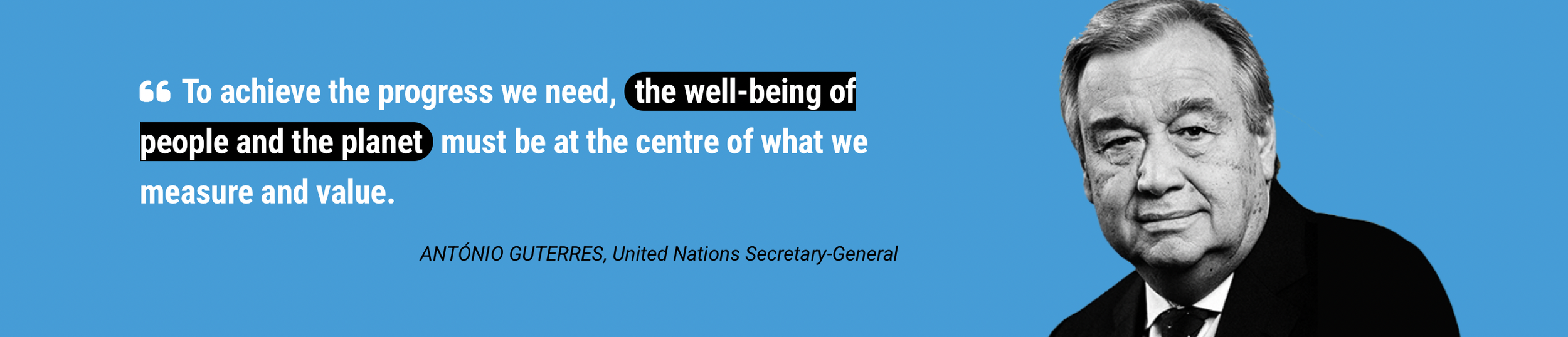
The UN’s Beyond GDP project is part of a global recognition that it’s time to move past an over-reliance on Gross Domestic Product (GDP) as the primary measure of progress.
In May 2025 the UN appointed an independent High-Level Expert Group (HLEG) on Beyond GDP. We welcomed the opportunity to contribute to this conversation, via our submission below.
Key points of our submission
We celebrate the focus of the expert group on current wellbeing, inclusion and sustainability as the key dimensions for moving beyond GDP.
We support a greater focus in the final report on an embedded model of the economy that explicitly recognises that our economies must operate within the limits of ecological systems and planetary boundaries.
We urge the HLEG to give greater consideration to how indigenous perspectives can be incorporated.
We urge the HLEG build on existing commitments towards intergenerational fairness, including the Pact for the Future and the Declaration for Future Generations.
Response to questions
1. What does “progress” mean to you — what indicates that your life/your community/your country/the world is improving?
We acknowledge “progress” will mean different things to different people at different times.
In an Aotearoa New Zealand context we surveyed New Zealanders in an Economics Listening Tour. Over winter 2023, WEAll AotearoaAotearoa Director, Gareth Hughes, embarked on a journey across the country to listen. His goal was to engage with everyday New Zealanders from different corners of the nation and walks of life, to hear their perspectives on the current state of Aotearoa’s economy and their aspirations for its future. A number of key themes emerged from participants’ experiences and observations:
People see a discrepancy between current economic values of individualism, competition, and profit and those values needed to ensure community wellbeing - care, connection, and equity.
People called for the need to widen the definition of what a thriving economy means, beyond GDP figures.
There was a shared concern that the environment has been neglected, as growth has been given top priority.
Aspirations for a new economy include a shift away from profit centred paradigms towards prioritising the care of communities and the environment, fostering whanaungatanga, and respecting Te Tiriti and indigenous values.
2. What are the three things that every country should measure to understand whether it is making real progress?
We celebrate the focus of the expert group on current wellbeing, inclusion and sustainability as the key dimensions for moving beyond GDP.
A key recommendation from us on this question is that citizens should be genuinely involved in the development of any measure to understand whether a country is making real progress, to build the legitimacy, public understanding and ongoing support for any such measure.
We note the Wales We Want citizen engagement that led to the Wellbeing of Future Generations Act (2015) and citizen assemblies as examples of this in practice.
4. What other contemporary changes and challenges need to be captured in how we measure progress over the next 10–30 years?
We support a greater focus in the final report on an embedded model of the economy that explicitly recognises that our economies must operate within the limits of ecological systems and planetary boundaries.
We recommend greater consideration of energy and resources as fundamental inputs to be factored in. We note declining global energy return on investment (EROI) figures can give a misleading picture when viewed through a GDP lens. If more energy and resources are going in to produce a unit of energy over time, GDP can be seen to be increasing while a smaller share of economic activity could be flowing to non-energy related end uses.
5. What elements of the interim report resonated most strongly with you? Why?
We note the HLEG’s inclusion of equity. GDP masks the unequal distribution of income and resources which can obscure government support for policies that would deliver dignity, justice and fairness.
A convincing story we tell in Aotearoa New Zealand of the shortfalls of GDP as a single measure of progress is that between 1984 and 2024, economic growth increased per capita real Gross Domestic Product by 75 per cent. Over the same 40 years, the percentage of children living in households with low incomes after housing costs increased by one-half, from 14% to 21%. Economic growth did not reduce child poverty in Aotearoa New Zealand but increased it.
6. What parts of the interim report felt unclear, unconvincing, or disconnected from today’s global challenges? Why?
We would suggest the HLEG would benefit from coalescing around a holistic definition of an economy - to build greater awareness that the economy is about more than money flows (what GDP measures) thus building the case for more fit for purpose measures.
We define an economy as a way of socially organising our collective resources to satisfy our needs, material and immaterial, both human and ecological, now and into the future. The economy is socially and environmentally embedded, which leads to another point; instead of three distinct pillars: well-being, equity and inclusion, and sustainability, we should conceptualize the economy as being fully embedded within society and that within the environment.
We recommend further consideration on sustainability. We recommend it is not solely about ‘how much well-being, inclusiveness, and equity will be enjoyed by individuals and societies in the future’ it is about planetary health. In Māori culture, humans are seen as deeply connected to the land and to the natural world and not separate from it.
Understanding and reflecting that human health is dependent on planetary health is vital for a measurement framework fit for our current challenges.
8. Are there any domains or dimensions you believe are missing — aspects that matter for progress but are not yet represented in the framework?
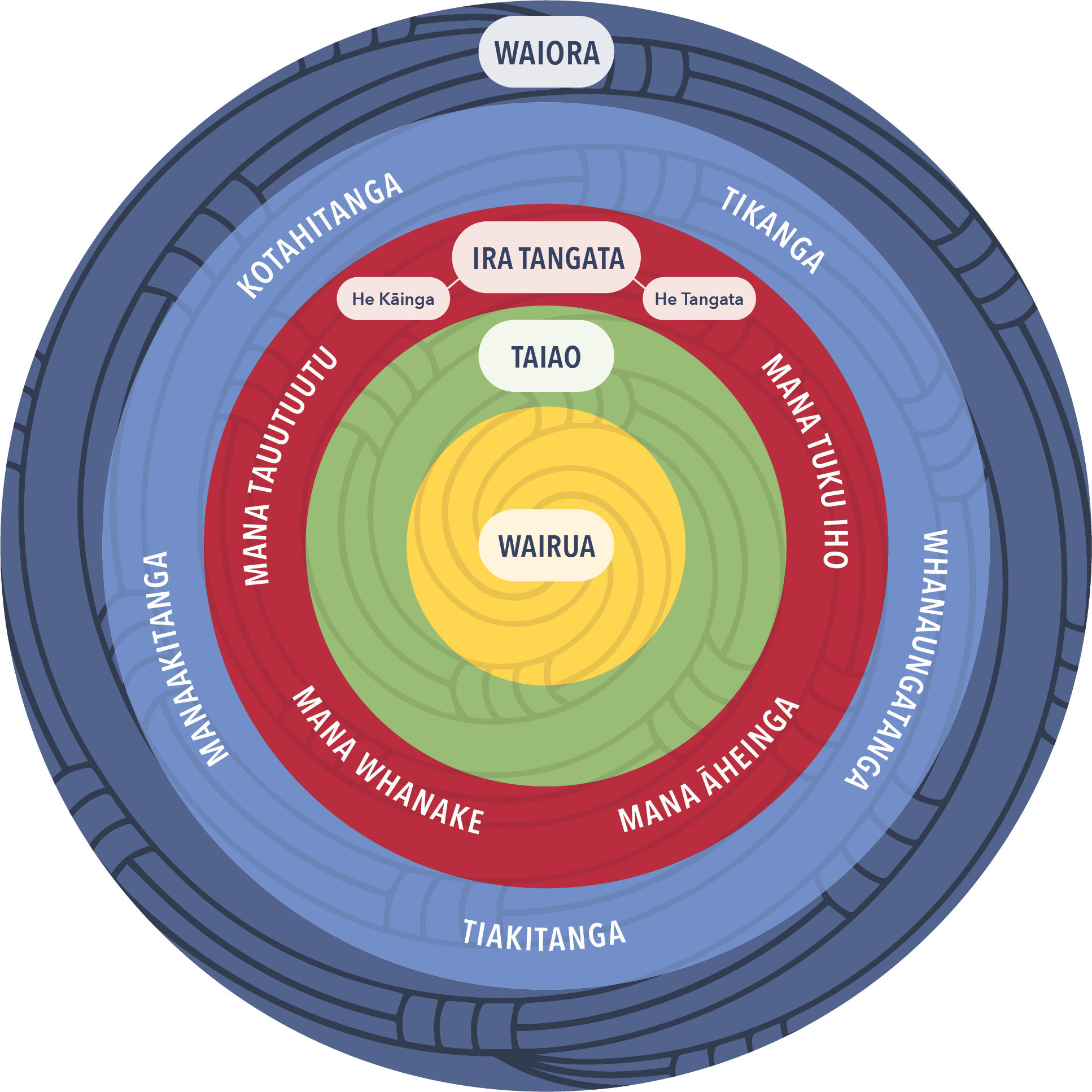
We note Indigenous rights and perspectives are not reflected in the current proposed domains. The strength of indigenous cultures and the ability to express identity is crucial. We would recommend the HLEG research Aotearoa’s New Zealand’s He Ara Waiora framework (pictured right) developed to contribute alongside the Treasury’s Living Standards Framework.
We note the key pillar of equity appears to be lost in the domains and not reflected in the example indicators. To address this; distribution should be its own domain with indicators such as wealth inequality, home ownership inequities. We would encourage HLEG to include ‘trust in others’ in the social capital domain.
It is unclear within the current domains where measures of intergenerational fairness and the rights of future generations would be incorporated, which they must to reflect HLEG’s commitment made in paragraph 9. This closely links to the mention of wellbeing interconnectedness across countries, which is not adequately reflected in the proposed domains. We suggest this could form part of a new distribution or equity domain.
We urge the HLEG to build on existing commitments towards intergenerational fairness, including the Pact for the Future and the Declaration for Future Generations.
10. What risks or barriers might limit the adoption of the framework in your context?
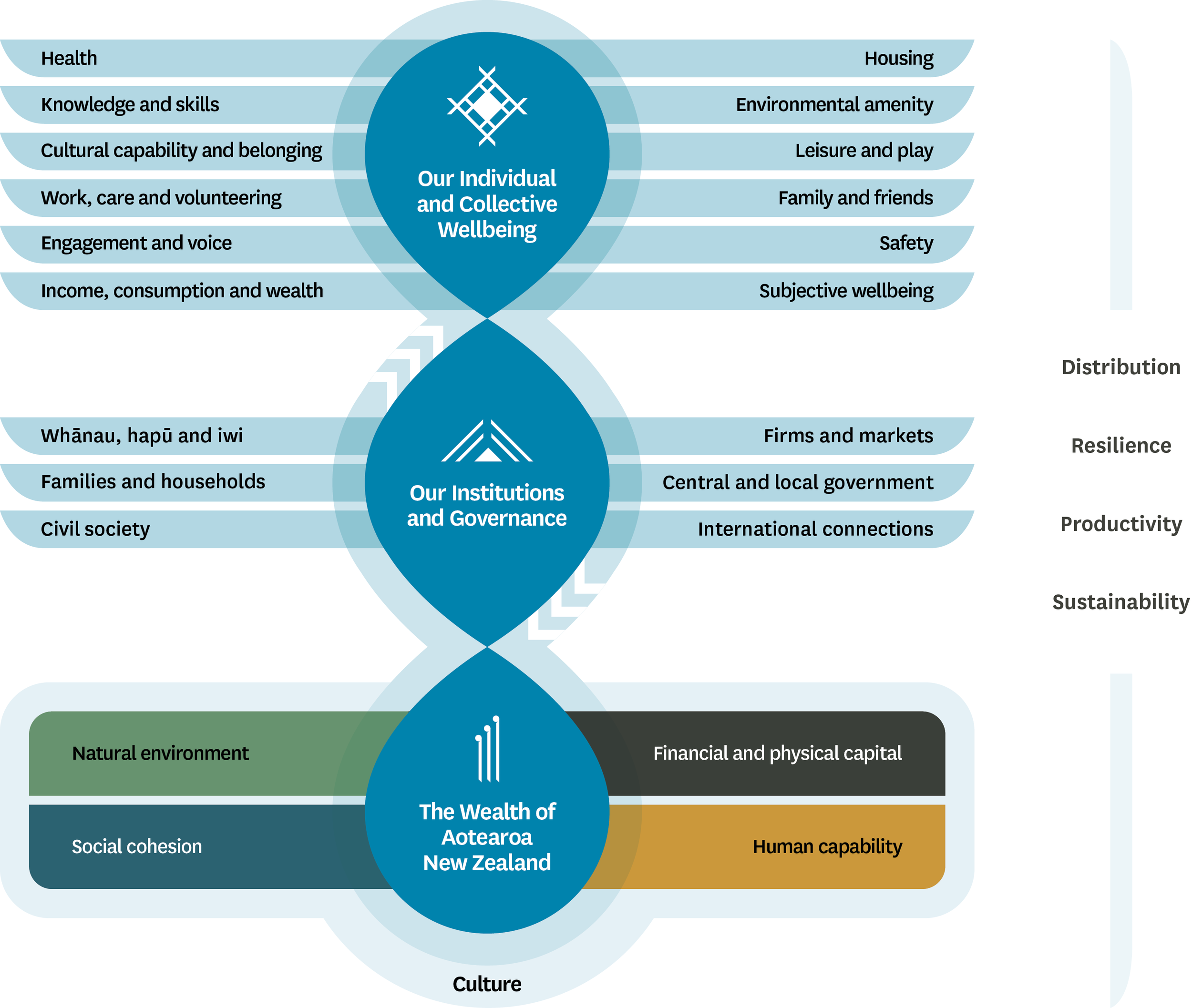
In the Aotearoa New Zealand context we submit that If the indicators are a selection of what is already included within our Treasury’s Living Standards Framework, that would improve uptake (pictured below).
In conclusion
WEAll Aotearoa appreciates the opportunity to make a submission and we would be happy to answer any questions about any aspect of our submission.
